Let’s stop using the term “beneficiary” in global development and philanthropic work, and let’s stop asking local organizations to spend hours of their time gathering details to satisfy our expectations of ‘beneficiary metrics’. Why? 🫴🏽 The word ‘beneficiary’ implies a benevolent giver of charity, and a passive recipient. The concept erases the agency, insights, leadership, … Continue reading
Filed under Sadaf Shallwani …
There’s a role for philanthropy amidst chaotic USAID funding freeze beyond being a band-aid (article in Alliance)
What is the role of philanthropy in the context of massive cuts to foreign aid in the US and elsewhere? In this article in Alliance Magazine, my colleagues, Nina Blackwell and Priya Dhanani, and I offer five guiding principles for philanthropy’s role in the context of the USAID shutdown and other cuts to overseas development … Continue reading
Reflections as I transition out of Firelight
Monday marked my last day with Firelight. When I joined Firelight in 2014, our mission was – as it is today – to support communities in Africa to care for their own children and youth. But, we were a completely US-based organization in terms of our board, our staff, and our systems and practices. Today, … Continue reading
Trust-based, reparative, and liberatory approaches to shifting power in philanthropy – Exploring the nuances
In philanthropy, there has been increasing interest, dialogue, and work towards shifting power and working towards equity and justice. In this context, different philosophies and approaches have emerged. On a list-serv that I am part of, a recent discussion emerged on the distinctions between three related but different paradigms that seek to shift power in … Continue reading
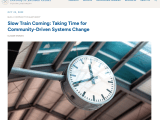
Slow train coming: Taking time for community-driven systems change (Guest post at the Johnson Center)
“A new generation of funders is radically challenging how the sector defines and achieves its goals — arguing that shifting power to communities is both more ethical and effective for long-term impact.” I am pleased to share this piece I wrote for the Dorothy A. Johnson Center for Philanthropy describing how Firelight came to develop … Continue reading
Solidarity over charity: Prioritising long-term shifts over band-aid responses (article in Alliance)
“Modern charity has largely failed to produce real, lasting change.” In Alliance Magazine, I explored how the framework of charity has failed to achieve lasting, systemic change or a shift towards equality despite the good intentions of funders and the billions of dollars that have been spent. I explore how solidarity offers a different framework, … Continue reading
Challenges of fundraising for community-driven action (Participatory Grantmaking Community discussion)
I was thrilled to join the Participatory Grantmaking Community for a conversation about the tensions of fundraising for participatory grantmaking (PGM) along with Paul-Gilbert Colletaz from the Red Umbrella Fund and Yodit Tesfamariam from Camden Giving. We started the conversation with some guiding tensions about whether it matters where the money for participatory grantmaking comes … Continue reading
Philanthropisms: Shifting Power & Supporting Communities
I had the opportunity to join Rhodri Davies for his podcast Philanthropisms to funding systems change, supporting grassroots communities and shifting power dynamics within philanthropy. We covered questions including the distinction between charity and justice, the impact of the “funder ego” or a “saviour mindset” on philanthropy, and how to design impact measures that are … Continue reading
Translating knowledge to action in ECD – but whose knowledge and whose actions?
I was pleased to join the Early Childhood Development Action Networks’ webinar discussing how we can translate knowledge into policies and actions to benefit children’s early development, particularly at the more local level. “When we talk about translating knowledge into practice, the question for me is which knowledge and whose knowledge. We often distinguish between … Continue reading
Conceptualizing early schooling in Pakistan: Perspectives from teachers and parents
As I was completing my doctoral dissertation on ready schools in Pakistan a couple of years ago, I was intrigued by the in-depth conversations I had with so many parents and teachers about what education and knowledge meant to them, and how it fit within their values and worldviews. So, I was thrilled when I … Continue reading